PROGRESSIONS FOR BREASTSTROKE – PART 1

LEARNING THE BREASTSTROKE TECHNIQUE FOR NOVICE SWIMMERS

Teaching swimming strokes with correct technique is slower at first but leads to safer swimming and a love of the sport.  Today what I witness when watching some swimming teachers is what I would call teaching survival swimming.  The basics are not perfected. It does take time and parents say they just want their child to be safe if he/she should fall in the water.  Teachers are then pressured to produce results quickly.  By teaching the technique progressively and correctly the child will become a better swimmer and because swimming becomes easier with correct technique they learn to love the sport and do better at it.  

This article is designed for the Novice swimmer learning their strokes.  The child should be water born and confident in the water. 

Do not be afraid to give teaching Breaststroke a try.  It can be difficult, but not impossible.  The main propulsive factor in Breaststroke is the leg kick, but the arm pull and timing are very critical too.  I will be doing articles on the Arm pull, Breathing and Timing at a later stage. 

I am sharing some ideas I use to introduce the stroke to the Novice learning from the “get go”. Where you see the abbreviation TP it stands for Teaching Point .  TP is a way of describing an action that the swimmer can visualize and then put into practice.

Body position

The basic push and glide should be taught at the beginner level.   Make it fun.

SOME DRY LAND EXERCISES TO SHOW THE CORRECT POSITION FOR A STREAMLINE   THIS CAN BE DONE BEFORE THEY GET IN THE WATER.

Lying on a towel on front

  1. Toes and legs must stay zipped together.
  2. Arms straight, extended in front of head, squeezing the ears.  
  3. Hands one over the other.     TP     “ Make a turtle”

Have competitions between the swimmers “who can do the best streamline?”

Example 3 x cactus arms hold 10 seconds – into the streamline position hold 10 seconds.

This exercise should be done everyday before they swim to make sure this very important position becomes a habit in the water too.  It is the basis for all strokes, turns and dives. 

In the Water

  1. Mushroom float .  Tuck up in a tight ball.  Knees to chest, heels to bottom, head on knees.

Make this fun.  “How long can you hold the float before taking a breath. “

  1. Keep the head down and open out in to a pencil position on the front. 

Once the streamline position has been developed we can progress to the Breaststroke leg kick.

Brief Description of the breaststroke kick.

The swimmer starts from a streamlined position on the front.  The heels are brought up towards the bottom with the knees hip width apart.  The feet are turned out into a Dorsiflexed position where the catch of the water takes place.  The swimmer continues by kicking slightly out and straight back with the heels and instep of the feet.  The kick accelerates to finish together with the toes pointed and ankles together.  TP “ Make the ankles kiss”. The legs can be lifted up together towards the surface in this position to get the body back into the streamline position ready for the next stroke.  Make sure the swimmer does not kick down again after the up kick. This would be considered a dolphin kick which is not allowed.  The kick is known as the WHIP KICK due to the speed the legs come together, like snapping a whip, quick and fast. 

DRY LAND PRACTICES 

  1. Swimmers lay face down on a towel, legs hip with apart and straight to begin with.  Ask the swimmer to bend their knees, keeping the upper leg flat on the ground.  Soles of feet looking towards the ceiling.  Take a kick board and place on the swimmers’ flat feet.  Ask the swimmer to lift the board upwards using their legs only.  I tell them to imagine they have a pot of tea, Cup and saucer on the board.  Both feet push the legs upwards.  You want the swimmers to think about lifting their heels up to their bottom and not bending at the hips. Practice this a few times so the swimmer can feel the process required.
  2. Repeat position number 1 without the kick board on the soles of the feet and try to replicate the correct leg action.

“Heels to bottom, turn toes out, kick back with heels, squeeze legs together, ankles kiss.”

Teaching the Breaststroke kick  In the water.

You can start in the water and manually go through the action of the kick while the child holds on to the side or holds two small kick boards, one under each arm pit.
For young swimmers and even adults I like to use 2 boards to begin with.  Breaststroke rule is all movements must be simultaneous and symmetrical.  This means the arms and legs move the same way on the same plain in opposite direction.  They mirror image each other. Using the 2 boards to begin with helps the beginner find their balance in the water.  Sometimes when only using 1 board the swimmer can lean to their dominant side and not remain on their front.  This can lead to what is called a screw kick or uneven kick which is illegal.

With one board held under each arm pit they float on their front with legs held straight out behind them. The swimmer can keep their head up at this stage.  Ask them to lift their heels up to their bottom, turn the toes out to face the lane ropes and then kick straight back and together.  Try to keep the knees close together during the recovery, shoulder width apart.  Ideally, you want the knees to be pointing towards the bottom of the pool.  TP   “Try to get the heels wider than the knees.”

You can try 2 boards held under the arms on the back too.  Now they must try to keep their knees under the surface.  There should be nominal flexing at the hips.  With this drill the child can see the legs and you can correct them as they try the movement.  The hands are kept by their legs and when they bend the knees they try to touch the fingers with their heels.  The swimmer can progress to a streamline position of their back, keeping their knees under the surface.

When we are at the beginner level teaching this stroke do not get too dogmatic about keeping the knees together or hip with apart.  It can be a very stressful movement to the knee joint for some pupils and they can experience pain or discomfort.  This will put them off trying the stroke.  At this stage do your best to make the kick legal.  If the swimmer shows potential for the breaststroke you can modify the kick later in their career.  TP”  “ Make the letter W”

Once they can perform the kick comfortably with 2 boards they can try with 1 board.  Recently I was introduced the ONECORE float designed by Jade Edmistone former Breaststroke World record holder. 

I find them excellent aids for all strokes especially Breaststroke.  I will put a link for her web site at the end of this post.

I, personally,  find I have to introduce the breathing at this point in the swimmers learning process. This can help with the timing of the Breaststroke later on.  Either using the one float or the Onecore float held in a streamline position the swimmer ‘s head lifts as the heels are recovering up towards the swimmer’s bottom.  TP  Heels up, head up”. The swimmer inhales then places the head between the arms as the legs kick back.    Hold the glide here.  You want the kick to take place when the head and arms are in the streamline position.  TP  “No gap between ears and arms.”  “Hide the ears” “ squeeze the ears tight”

This will make the swimmer faster as there will be minimal drag from the head being kept up.  This will take time and patience, but very beneficial later on when they start training Breaststroke.

The swimmer can follow with the above exercise, but not using and float, just keep the arms streamlined in advance of the head.  

Now we can go to  Part Two  Introducing the Breaststroke Arm Pull

MAKING FREESTYLE BETTER

I am going to work on improving the Freestyle I teach and coach with various methods I have looked at.  Some are from Karlyn Pipes-Neilson and the Dutch coaches Stewart Melton talked to at his British coach’s conference and Bill Furniss.

  1. The body position must be horizontal and streamlined. The top of the head should be in the water and the eyes must look down.
  2. The hands enter in advance of the head  in a line with the  shoulders ,kicking should be done with the arms stretched out in front , shoulder width apart.
  3.  Arm pull : Fingers enter the water first in advance of the head approximately a hand space away from fully stretched.  Extend in front .The fingers slide forward and the back of the hand is as close to the surface as possible. The hand and forearm press slightly down to the catch position.  Think about the area from forearm to fingertips.  ( Press up action).  At catch position the forearm and hand form one paddle, the elbow bends and the forearm and hand press downward to a position directly in line under elbow with the fingers pointing to the floor.  It is a wide pull/press.  Keep pressing the hand, forearm paddle with the fingers pointing down to a point where they feather out of the water, out and round in a relaxed recovery position.  This is much more relaxed than the traditional elbow out first recovery.  The later puts a lot of strain on the rotator cuff.  There should not be too much rotation from side to side.  It is the extension of the arm on entry that gives the body the rolling action from side to side.

TEACHING PRACTICES  Use Beeper for tempo.  Beep (hand in) Beep (other hand in)

  • DOG PADDLE DONE FAST HEAD UP GETTING THE ARM AND FOREARM TO ACT AS ONE PADDLE AND PRESS DIRECTLY DOWN AND FORWARDS AGAIN. ( Gives a fast catch)
  • WATER POLO STROKE HEAD UP TEACHING POINT  FINGERS POINT TO FLOOR. WIDE PULL.  RELAXED RECOVERY.  FEATHER  ARM OUT AND ROUND TO ENTRY.
  • SAILING STROKE FROM STEWART FOR OLDER SWIMMERS.
    Have swimmers put finger tips on wall and keep forearm and fingers in a line.  Lower arms level with forearms and fingers.  Slow.  Imagine a sheet of glass.
    Think about putting fingers on a box and press up.  Open hand helps to reduce tention.  Learn to use lower palm and wrist instead of fingers.  Try pushing against another person.  They hold their hand up in front of you and you try and push them down using fingertips. You will feel the tension in forearm and shoulders.   Then use the lower palm and wrist instead.  The fulcrum is the wrist and you use the latimus muscles, much easier and stronger position.
    1 Hand position     2 Fingertips placement    3  Wrist awareness  4  Umph at the front  5   Exiting the stroke (feathering out)
  • CATCH DRILL
    Face down in the water left arm extended in front opposite arm at hip.  Press forearm down under the water until directly under elbow, fingers pointing to the floor.  Return to extended position and roll head towards side of arm on thigh.  Upper arm must stay parallel to the surface. T.P. Centre elbow over hand must keep length.
    FAULTS: Forearms pulling too wide or coming inside the elbow.  MUST BE IN LINE WITH THE ARMPIT.. Keep hand on hip as still as possible.  Don’t go for speed go for strength and feel.

TEACHING THE BUTTERFLY STROKE

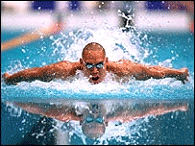
The World famous Michael Phelps shows good form in this picture. Chin on the water to breathe, arms carried laterally over the water with little finger on the top and thumb just brushing the surface.

This article is for teaching the butterfly stroke.  I will do an article at a later stage to cover the coaching of the stroke.  The double arm and leg movements demand a lot of strength and power from the swimmer and I do not recommend teaching the whole stroke to young swimmers.  Get the other 3 main strokes under your belt first.  Saying that, you can start teaching the dolphin leg kick at any time as it is now used in the flutter strokes underwater for faster performances.  The children love to kick like a mermaid or a dolphin and can spice up a swimming lesson or are used as contrasting activity at the end of a lesson, wiggling through hoops etc.

The World famous Michael Phelps shows good form in this picture. Chin on the water to breathe, arms carried laterally over the water with little finger on the top and thumb just brushing the surface.

BODY POSITION

As in all strokes the body must be horizontal and streamlined.  The teacher/coach must make sure the swimmer can push off the wall in a streamlined position initially on the surface and progress to dropping down under the water and pushing off under water and maintaining a streamlined body position.  This takes time and must be worked on continually.  Apart from teaching the swimmer the position needed for their body it, also, develops the legs muscles needed for the push off’s in their turns and eventually the leg drive needed for their dives.  You cannot practice this enough!

Body should be either in the prone or supine position.  Legs together, toes pointed, arms extended in front of shoulders, head positioned between the arms, ears squashed between the arms, one hand on top of the other.  There should be no gap between the arms and the ears. The top hand must be locked over the bottom hand, also, no gaps.

Teaching points:

  • Pretend you are swimming through a straw
  • Like a pencil
  • One hand on top of the other looks like a turtle
  • Hide the ears
  • Look at the floor (prone position)

In all your strokes, if you wish to swim fast, you have to maintain this streamlined body position.
How is this done?   The kick maintains the body position.
Why?   Kicking is an excellent conditioning exercise.  Not only for the legs but for the abdominal and lower back muscles which help the swimmer’s streamlining ability, body position and alignment in the water.

The streamlined body position can be learnt from the learn to swim stage and be continually worked on throughout their swimming career.  As their drive off the wall improves you can incorporate the butterfly kicks and flutter kicks allowed now in all competitive swimming events, except breaststroke.   Always maintaining that streamlining position.  Never allow sloppy push off’s.  Peat and repeat until it becomes automatic for the swimmer.

BUTTERFLY KICK OR DOLPHIN KICK

FINA RULE

SW 8.3 All up and down movements of the legs must be simultaneous. The legs or the feet need not be on the same level, but they shall not alternate in relation to each other. A breaststroke kicking movement is not permitted.

Requirements needed

  • Core body strength
  • Good hip and pelvis flexibility
  • Good ankle plantar flexion

DESCRIPTION of the dolphins leg kick

The legs kick up and down in a symmetrical and simultaneous movement. The legs begin fairly straight during the up kick.  The movement is initiated in the upper abdominals and thoracic spine (mid to upper spine) with the aid of the lower paraspinal muscles (muscles which run alongside the spine) which contract (tighten).  This extends the thoracic and lumbar spine, which in turn posteriorly rotates the pelvis, extends the hips and flexes the knees and the feet are drawn up to the surface.
During the down kick the reverse action takes place. The abdominals contract and this makes the thoracic and lumbar spine flex making the pelvis rotate anteriorly, flexing the hips, extending the knees and the feet are drawn down ending with the legs in a hyper extended position (straight).  The movement is rhythmic and fluid.  It is a whip like action.  The whole leg is used not just from the knees down.

TEACHING THE KICK

Personally, I start teaching the dolphin kick without using a kick board.  In fact, I try never to use a kicker board when teaching or training dolphin kick.  A few years back Professor Cameron from the  ASA Olympic committee did a series of tests with butterfly swimmers and found that the use of a kick board, especially while using fins caused swimmers to develop injuries in the lower lumbar areas especially later in their careers and retirement.  The whip like action on the down kick causes the energy generated to jar the lower area of the back when the swimmer is using a kick board especially when using fins as well.  When no board is used the energy is allowed to travel out through the head and no jarring occurs.

Try it yourself and you will feel how there is a continuous pressure on the lower lumbar area when using a kickboard and fins.

METHOD

The swimmers lie on the tummy in their streamline position and tell them to push the chest down into the water and let their bottoms rise and then visa versa, chest up and bottoms down.  They can do this with the hands by the side to begin.  They continue the movement trying to get to the other side of the pool.  They must do 3 – 4 movements without breathing and push the chin forwards to grab a quick breath and then the head returns to the streamlined position with the eyes looking towards the bottom.  Do not tell them to do anything with the legs as this movement should make the legs do a gentle butterfly kick as long as the legs are relaxed.

Once this has been established try to extend the arms in front of the head in the streamlined position and perform the same movement breathing every fourth kick.  Slowly build up the strength in the kick by doing short distances with short to moderate rest intervals.

The goal is for a quick movement from the legs and this take strength and practice.  Your goal should be to execute 3 kicks per second!  Yes, 3 kicks per second.   Make sure the kick stays in the water.  Ideally, the feet must not come out of the water during the kick except maybe the heel can break the surface.  If the feet or lower leg are clearing the surface there is too much bend at the knee.  Experiment with kicking underwater and trying to go further doing the dolphin kick underwater.  Make sure they do not slow down to go further though.  Start timing their breakouts and seeing how far they can go.  All kicking practices can be done with and without fins.

Teaching points:

  • Legs together like a big fish’s tail. Kick up and kick down.  Bang, bang fast with the feet.
  • Kick the head down, kick the head up.
  • Chest up, bottom down. Chest down , bottom up.
  • Like a wiggly worm.
  • Like a mermaid

Once the swimmer is kicking a good streamlined dolphin kick you can now introduce other aspects of the stroke.  Scull with arms extended in front of shoulders in co-ordination with a down kick.  Do 3 – 4 sculls then take a breathe.  This is introducing the first kick in Butterfly stroke which is co-ordinated with the outward scull.  Scull out, kick down, scull out, kick down etc.  The scull inward is where the legs are kicking up getting ready for the next kick down.  Get the timing of this first kick down to co-ordinate with the first scull out.

Place the hands at the hips and push back with both hands as you perform a down dolphin kick.  This is for the timing of the 2nd downward kick in the Butterfly stroke.  Again do several push backs timed with a down kick and take a breath.  Try to keep the arms fairly straight doing this drill.  You do not want them to bring the hands up past the belly button. It is just a push from the hips to the upper thighs.

Now you put the 2 kicks together. i.e.  scull out in front as you do a downward dolphin kick, push back towards the hips with both arms as the upward kick takes place and perform a downward kick as the hands reach the hips.  Recover the arms underwater towards the streamlined position back in front.  This in known as underwater recovery drill.  It teaches the swimmer the timing of the 2 kicks in Butterfly stroke. The chin is pushed forwards as the arms are pushing back to the hips to breathe and the head goes down as the arms are pushed forwards to start the next stroke with eyes looking down.

Teaching points.

  1. Kick in, kick out.
  2. Kick, pull, kick.
  3. Accelerate arms past hips
  4. Chin on water when you take a breathe.
  5. Make a big white beard round your chin.
  6. Eyes down

NOTICE THE WHITE BEARD AROUND THE CHIN WHEN A BREATH IS TAKEN.

 BIONDI DRILL

The next progression is similar to underwater recovery drill but this time the swimmer does  4 streamlined dolphin kicks and then the push back to the thighs with a breathe.  The swimmer recovers the hands towards the front underwater, and drives the head in on the first dolphin kick.  Make sure the swimmer does not go too deep on this drill. Some part of the back must be dry at all times.   There is some undulation in the butterfly stroke but you do not want the swimmers to submerge too deeply.  The swimmer needs to be as horizontal as possible.

Next progression is to do 2 x Biondi drill followed by 4 dolphin kicks and a normal over the water butterfly arm stroke.

1 x Biondi drill followed by 4 dolphin kicks and a normal over the surface arm stroke.

You can progress with as many variations to this as you want to get the correct movements required.

You can do  25m with or without fins using a variety of kicks and arm movements.  6  streamlined dolphin kicks + 1 butterfly arm stroke landing the arms out in front for the next 6 kicks or  4 dolphin  kicks + 1 normal butterfly arm pull land in front.

Once they can do the 4 kicks one pull they must try and get 2 arm pulls into the 4 kicks.  Normal butterfly in other words, breathing on the 2nd pull only.
Always aim for great technique at all times.  Hips must ride the surface.  You need a strong leg drive to swim a great Butterfly stroke.  Emphasise that the arms must be relaxed during the recovery.  Enter the water softly with the fingers first, not the thumbs, about shoulder width.

FINA RULE FOR THE BUTTERFLY ARM PULL

SW 8.2 Both arms shall be brought forward together over the water and brought backward simultaneously through-out the race, subject to SW 8.5.

DESCRIPTION of the Butterfly arm pull

The Dolphin arm action is a continuous, simultaneous movement.

Entry:  The hands enter the water, softly, fingers first in advance of the head in line with the shoulders.  The arms should be stretched forward with a slight elbow bend to allow the soft, no splash entry.

Catch: The pitch of the hands changes to a down and out angle.  The catch is made just outside the shoulder line. The palms remain facing in the direction of travel.  The elbow bends to an angle around 90 degrees to aid the powerful push back.  The hands sweep in a circular movement out, round and together, with the thumbs coming almost together around the throat and chest area.

Upsweep: The hands change to face out and up towards the surface.  The elbows extend fully to straighten the arms and hands towards the thighs.  The hands must accelerate towards the thighs.

Recovery: The hands, little finger first, exit the water and the arms are thrown laterally over the water back to the entry position, keeping the little finger on the top and the thumb just brushing the surface.  The elbows bend slightly just before entry in order to make the entry smooth.

METHOD

Also, refer to previous paragraph on Biondi drill.

Angel drill

The swimmer lays in the prone position, eyes down, arms extended in front.  The arms are kept straight and travel out, around and back towards the hips in a circular movement and then back in a circular movement to the front.  The arms do not go under the water but stay on the surface throughout.  They can do a gentle flutter kick to keep on the surface or lay on a kick board when  they do the movement.  If they do need to breathe they just life the chin and take a quick in breath but it is better if they can hold their breath during the circular movement.

Push up

Swimmers get into the water and face the side.  Put their hands flat on the top of the pool surround and perform a push up.  Try to push both hands and arms at the same time until the arms are fully extended.  Hold this position.  Explain to the swimmer that this is the underarm action needed to do the Butterfly.  You will see that their hands are placed on the side about shoulder width apart for the easiest way to do their push up.  The same principle applies when they swim Butterfly.  The hands must be shoulder width apart as this is the easiest and most powerful way for them to push back.

Combine Angel drill and the push up drill

Do the Angel drill laying on the kick board.  Arms do the circular pattern from outstretched in front and round to the back and return to the front.  From the extended arm position they do a push up underwater to the thighs as they did at the side of the pool and recover the arms out of the water back to the front.  Sometimes, the push back has such force that they FLY off their kick boards.  This is fine and gives the swimmer the idea of the movement required.
All drills for Butterfly can be done with fins to help the swimmer get the rhythm and help keep the hips high.

Single arm butterfly drill

Left arm held straight in front while using the right arm to pull.  Breathe to the side at this stage.  Do the drill slowly and get the rhythm.   Kick as hand goes in and kick as hand comes out.  Emphasise to keep the hand moving.  Do not dunk the head in.  The head enters the water just before the hand.

Try with the other arm pulling.  Progress to doing 2 single arm pulls with the right arm and the 2 with the left.  Introduce alternate single arm pulls and then a double arm pull.  You can use as many variations as you can think of to make the swimmer achieve the correct rhythm and co-ordination.   Do not do a lot of full arm butterfly in the learning stage.

Good luck with teaching Butterfly.  The swimmers love to swim this stroke and it is such a beautiful stroke to watch.  This is only a few of the methods I have tried and used.  I hope you find them useful.

A BRIEF BREAKDOWN OF THE BREASTSTROKE FOR THE AGE GROUP SWIMMER

During training it is best for the coach to introduce components of the stroke rather than teaching/coaching long distances or repeats of the full stroke.  There should be maybe a 20%-30% only of the full stroke.  In modern Breaststroke the swimmer has to maintain high hand and heel speed which becomes very tiring if done for long distances.  It is important to maintain proper stroke mechanics at all times.

BODY POSITION
As in all strokes the body position should be streamlined and horizontal.  The swimmer must “ride the line” at the surface.

KICK
The rules of the stroke say that the legs must be simultaneous and symmetrical at all times.  They “mirror” image each other in other words.  In teaching the kick it is not always possible to get the learner to do the “Whip” kick due to their body structure or flexibility.  Whatever the case always aim to make the stroke legal.

The kick begins in a streamlined, horizontal  position, toes pointed.  The knees bend and the heels are drawn up towards the buttocks with speed.    There should be no bend from the hips.  The knees are pointed towards the bottom of the pool about hip width apart with the soles of the feet looking at the ceiling.  The feet flex out as if to look at the lane line and the heels kick back, down and together as fast as possible.  At the end of the kick the feet are flexed so that the soles are together and pointed for a more streamlined effect.

ARM PULL 
The arm stroke must always start and end in the full extended position no matter how brief.  Stress extending into the “Outsweep”.  There are 3 sweeps in the arm pull.

OUTSWEEP,  INSWEEP, RECOVERY

  • Outsweep:  starts off  slow and arms must remain straight with even speed.  This is where the set up is made for the most propulsive INSWEEP occurs.  The arms sweep out to a position wider than the elbows, but not too wide, thumb down.  The distance of the OUTSWEEP depends on the swimmer.  Men usually can pull from a wider position than women.
  • Insweep: Speed increases, fast, insweep which is carried through to the recovery phase.  The inside edge of the arms ”the blade” , thumbs down takes the lead. “The blade” extends from finger tips to elbows and sweeps out, down and round with the elbows remaining high and anchored in place.  Keep the elbows high through out the insweep.  The “blade” is like a propeller with the little fingers  sweeping together, elbows trailing.  The hands are higher than the elbows at this point.  Through the insweep phase the shoulders and back lift while driving forwards. NOT BACKWARDS OR UPWARDS.
  • Recovery (faster): Hands are kept together with the elbows, also close together, through to the extension in front. The hands recover facing palm down.  Hands must travel straight forwards – NOT DOWNWARD.   As the arms recover the head is kept in line with the back and “settles” between the arms ending the stroke cycle in a streamlined position.

T.P.

  1.   Hands come up in to a “Cat’s Paw position”
  2. Hands pull the forehead forwards and down to a streamlined position.

TIMING
The arms should almost be back in the streamlined position before kick.

T.P.

  1.  Pull, breathe, kick, glide
  2. Heels high, knees point to floor.
  3. Kick with the heels
  4. Fast feet.  Ankles kiss.

BREASTSTROKE DRILLS
KICKING  

  1. Use a board, hold the end of the board, fingers on top.  Breathe, kick, glide let face full in.
  2. 8 x 25m kick 45secs at the wall 15secs rest interval.
  3.  3 Full strokes under/ 3 strokes on top.
  4. 2 kicks + 1 pull variations re numbers can be done.
  5. Kick free or fly with breast arms.
  6. Use a tennis ball under chin to get correct head position for the breathing.